
Patient monitor Continuous monitoring of physiological variables is very essential in many cases such as: stroke, post-surgical operations, and after severe accidents.
Patient Monitor
Continuous monitoring of physiological variables is very necessary in many cases such as: stroke, after surgical operations, and after severe accidents. The devices that do this are called vital signs monitors.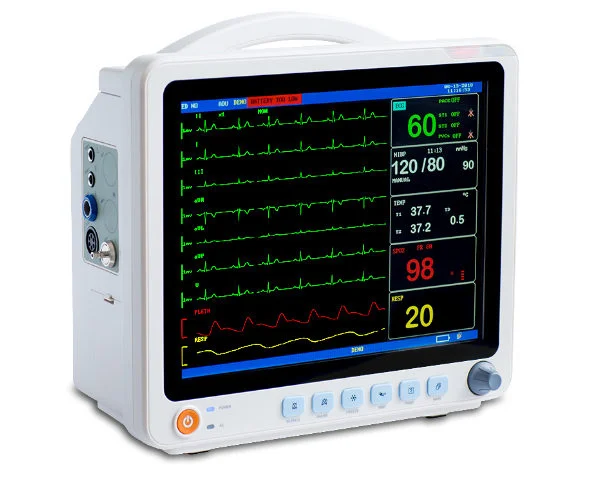 organs.
Vital signs monitors are devices used to monitor patients in intensive care units ICU, cardiac care units CCU, and operating rooms OR. They have the ability to monitor the patient's condition by recording and displaying continuously in real time for long periods with date and time, so that the doctor can verify the patient's condition moment by moment and respond accurately and effectively to the patient's needs in appropriate ways according to what the patient's condition requires.
The device monitors the patient's heart rate and can measure blood pressure and also measures temperature..
The device can also measure blood sugar level and extract brain signals.
Patient monitors:
Monitoring devices are divided into two categories according to their function:
1- Bedside monitors: These devices are placed above the patient's bed to monitor the patient's condition closely.
2- Central monitors: These devices are located at the central monitoring station to monitor patients' conditions remotely.
Components of the monitor:
1- The patient: from whom the required variables are taken via transducers and electrodes.
2- Electrodes: placed on the patient's body at specific locations to take the required variables.
3- Transducers: through which physiological variables are converted into electrical signals that can be amplified, processed, analyzed, and then displayed.
4- Variable processing units: These are electronic circuits to which transducers and electrodes are connected.
5- Computer unit: Its purpose is to control the other parts to store patient information and retrieve it when needed.
6- Power amplifiers: to amplify signals for display or printing.
7- Alarm devices: These are audible or visual indicators in case of abnormal readings.
8- Screen: to display the variables.
9- Printer: to print the variables.
Uses and applications of the device:
The device displays and records several variables, the most important of which are:
1- ECG: In this case, the ECG circuit is simplified because we are not concerned with the accurate readings of wave height, but rather the most important thing is their general shape.
2- Heart Rate: i.e., the number of beats per minute BPM.
3- Invasive blood pressure IBP and non-invasive blood pressure NIBP.
4- Respiration Rate: displays the respiration signal and rate per minute Rate/min.
5- Blood oxygen level O2: which is the percentage carried by red blood cells.
6- Temperature: which is the patient's body temperature.
7- EEG signal: This signal is available in some devices.