 ...
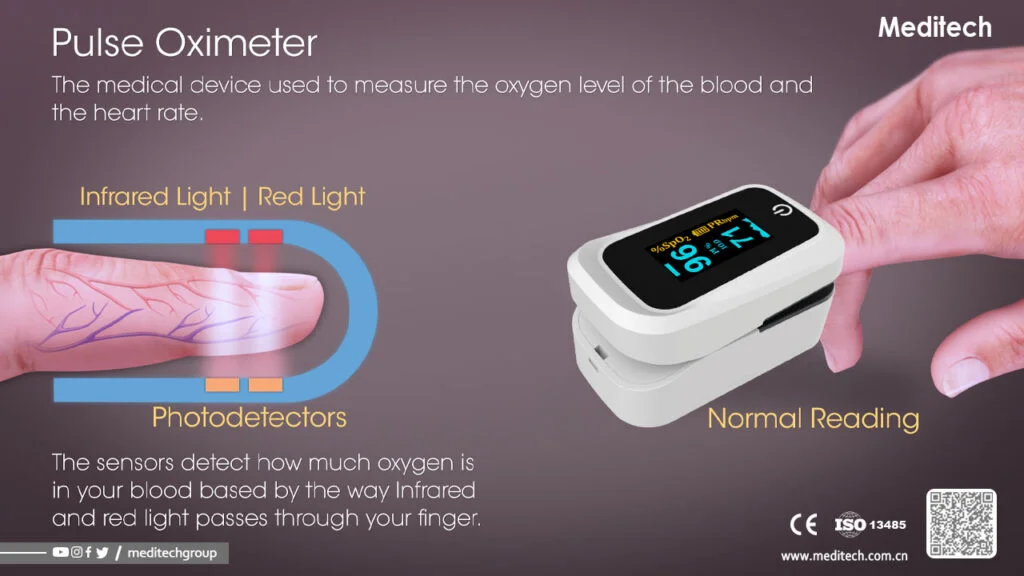
Pulse oximetry is a non-invasive test that measures how well the heart pumps oxygen throughout the body. A pulse oximeter is a small, clip-like device that uses the principles of simple spectrophotometry to measure the absorption ratio of oxygen-saturated hemoglobin
How the device works
The relative absorption of red light (absorbed by deoxygenated blood) and infrared light (absorbed by oxygenated blood) during systole tells us the level of oxygen saturation in arterial blood. A well-pumping heart maintains the oxygen saturation level
For a healthy individual, oxygen saturation should be above 95%, although in those with long-term respiratory disease or cyanotic congenital heart disease, it may be lower, corresponding to the severity of the disease. 92% indicates possible hypoxia. The oxyhemoglobin dissociation curve becomes sharply steep below about 90%, reflecting the rapid rate of desaturation that occurs with decreasing partial pressure of oxygen. This is the minimum oxygen saturation level needed to maintain the health of body cells; sustained states of low oxygen saturation levels may cause harm.
History and use
Pulse oximeters are useful for anesthesiologists as they are used for continuous assessment of hypoxemia during anesthesia to diagnose obstructive sleep apnea
A pulse oximeter is also a cheaper, easier, less painful, and more accurate alternative to blood gas analysis in many clinics. It is used to monitor individuals with conditions such as COPD, asthma, pneumonia, lung cancer, anemia, and heart attacks, where blood oxygen levels drop
There has been increasing interest in using fetal pulse oximetry in conjunction with routine cardiac monitoring, although its use does not reduce the surgical delivery rate. The safety limits for oxygen saturation are higher and narrower (95-97%) in children compared to those for adults
In addition, some other common uses of pulse oximetry include the following:
To verify the performance of a new drug for lung disorders
To assess the usefulness of a ventilator
To determine the effectiveness of supplemental oxygen therapy, especially when the treatment is new
To estimate how much physical activity a person can tolerate
To assess the lungs of newborns
Sources of error
Pulse oximetry is usually a fairly accurate test. It consistently provides results within a range of plus or minus 2%. For example, a reading of 82% indicates an oxygen saturation level between 80-84%. However, there may be fluctuations for the reasons listed below:
Different forms of hemoglobin cannot be differentiated using the pulse oximetry procedure. Carboxyhemoglobin is recorded as 90% oxygenated hemoglobin and 10% saturated hemoglobin, leading to an overestimation of true saturation levels.
Significant venous pulsation occurs as such in tricuspid valve insufficiency and venous congestion.
Environmental interference such as excessive movement or vibration, and even high levels of ambient light, including infrared heat lamps.
Cold hands and nail polish may cause incorrect readings.
Intravascular dyes, such as methylene blue chloride, may temporarily and incorrectly reduce saturation readings.
Conclusion
Pulse oximetry has become an important diagnostic tool and safety indicator. It brings particularly vital information to the operating room, intensive care unit, and neonatal care, and generally, it is used as a safety indicator for many inpatients. It is important that pulse oximetry be available in treatment facilities
In most high-income countries where pulse oximetry is universal across the perioperative process, anesthesia has become very safe: mortality rates directly related to anesthesia are usually less than 1 in every 50,000 procedures. However, these rates in low-income countries are at least ten times higher
Pulse oximetry has been updated to the highest level of recommendation in the updated 2010 international standards for safe anesthesia practice, which were developed and adopted by the World Federation of Societies of Anaesthesiologists, and it is essentially essential - and dangerously scarce in low-resource countries
Disclaimer: The information does not in any way constitute, or should be interpreted as, medical advice. The above article is also not an endorsement of any research findings discussed in the article, nor an endorsement of any of the source publications