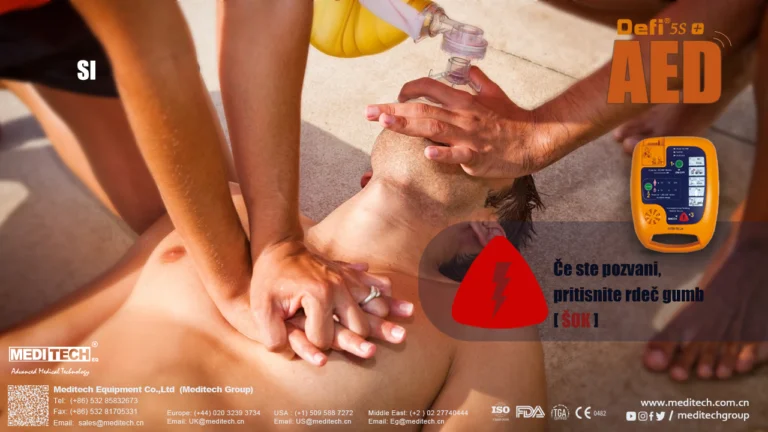
What is a defibrillator? The cornerstone in cardiopulmonary resuscitation cases in emergency departments is the defibrillator device during the resuscitation process and the changes that occur and vary during the resuscitation process, as it is the most complex process in the medical field, since the diagnosis changes by the second and the intervention changes accordingly by the second. You can encounter four diagnoses in a minute or two, all of which are either fatal or fatal. Let us briefly engage in a scientific discussion around the following axes: What is a defibrillator? What are the types of electrical defibrillation? What are the differences between them? What are the indications for each type? Are there any precautions that must be taken when delivering shocks? And finally, what is the mistake or (crime) that many doctors commit, with the blessing of many nurses, during the CPR process?
(defibrillator) The cornerstone in cardiopulmonary resuscitation cases in emergency departments
device, shock, electric, defibrillator
During the resuscitation process and the changes that occur and shift during the resuscitation process, as it is the most complex process in the medical field, since the diagnosis changes by the second and the intervention changes accordingly by the second. You can face four diagnoses in a minute or two, and all of them are either fatal or fatal
Let us briefly engage in the scientific discussion around the following axes:
What is a defibrillator?
What are the types of electric shocks?
What are the differences between them?
What are the indications for each type?
Are there any precautions that must be taken when administering shocks?
And finally, what is the mistake or (crime) that many doctors commit, with the blessing of many nurses, in the CPR process.
1. The device emits electrical waves measured in electrical joules to give the body an electrical dose that is released in a quarter-second burst to the first point in the heart AS1, then travels in less than a second AS2 to the bundle of His, and then performs the heart's electrical function from an external source.
2. The electricity released from biphasic devices is biphasic and monophasic is uniphasic, meaning the joule in biphasic is divided by two, while in monophasic the joule given remains the number on the screen.
The technique of administering shocks is known as a medical procedure, and everyone is aware of the importance of the gel and not touching the patient and the bed while administering shocks.
3. Many doctors repeat the procedure more than necessary, and I have reviewed several studies, some of which relied on the fact that shocks do not give results after the fifth to seventh time, and the best number is three, starting with 100, then 150, then 360 joules.
4. You can examine the heart from the pads on the patient's chest to feel the pulse with modern devices.
Types of shocks are two types:
non synchronized or defibrillation
Synchronized or cardioversion
The differences between them
non synchronized or defibrillation
1- Non-synchronized electric shock (meaning we determine the time of charge discharge) by pressing deliver
2- high joule, we often start with 200 joules, of course for adults...a
3- We start with three consecutive shocks J200, 300 J, 360 J from lowest to highest.. and it is repeated after performing CPR for one minute and the rhythm has not changed
As for Synchronized or cardio version
1- A shock synchronized with the onset of the R wave.... We do not determine the time of discharge.. We press discharge but the device chooses the appropriate time for discharge
2-low joule, sometimes from fifty or 100 joules
3- The patient must be given a dose of sedation and analgesic, even if the patient is unconscious, at least an analgesic must be given..
4- One shock is given.. then it can be repeated as a single shock
Precautions that must be taken before administering the shock
An Intubation set must be prepared next to the patient, oxygen must be given, and a suction device must be prepared before administering the shock
Note:
The device in synchronized mode does not wait for the rhythm to change because the rhythm is already abnormal, but it waits for the onset of the R wave, because if the shock is given during the T wave, the patient will be done for, defibrillator eek.gif defibrillator eek.gif defibrillator eek.gif because it will convert the rhythm to ventricular tachycardia, which is a fatal rhythm.. and this is a crime committed by many ignorant healthcare providers, and they bury the patient with their own hands without even knowing
Indications for non-synchronized shock.. Non synchronized
1- pulselss ventricular tachycardia
ventricular fibrillation-2
Indications for synchronized shock Synchronized
unstable tachycardia means a group of heart rate irregularities provided that they are accompanied by a drop in blood pressure, and they are:
1-Atrial fibrillation <<<< AF
2- Atrial flutter
3-ventricular tachycardia
4- supra ventricular tachycardia <<< SVT
But if the pressure is normal, one must start by giving medications such as digoxin, adenosine... isoptin... cordarone... and when the pressure drops as a result of synchronized shocks.
The fatal mistake that is repeated daily without any overseer or reckoner,,,
When the ECG shows a ventricular tachycardia (VT) rhythm and the doctor proceeds to give a non-synchronized shock, which is non synchronized or defibrillation
before checking the pulse, he treats it as if it were pulseless ventricular tachycardia, but in reality it could be ventricular tachycardia with a pulse present,, meaning both diagnoses are represented by one ECG
Pulseless ventricular tachycardia is a fatal diagnosis,, and ventricular tachycardia with a pulse present is a diagnosis that is not dangerous once, but after the wrong shock we convert ventricular tachycardia from having a pulse to not having a pulse and we kill the patient,,, quite simply,,